








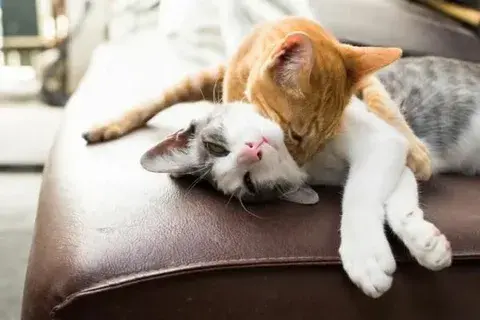
It is thrilling to take home another cat. It may however cause tension in case your cats do not hit it off immediately.
A question many American pet owners ask themselves is How To Make Cats Get Along with each other particularly in a house where space and attention is shared.
Cats are creatures of territorial character. Luckily, even the most obstinate cats can be made to coexist if they are introduced properly and in the right environment.
This blog describes each procedure. It also has 8 Tips to Help Cats and Dogs Get Along Together in a multi-pet home.
To get more tips on pet care, guide to animal behavior and expert guides, visit Animals Pet Health, your one stop source on everything pets.
Why Cats Don’t Always Get Along
Cats are self reliant animals. They do not necessarily create social stratifications, as dogs do. The majority of cats like their own space. They also appreciate possession of resources such as food, litter boxes and resting areas.
A new cat can make your resident cat feel like he has been intruded. Knowing this will enable you to do the right things. Consequently, you will be able to facilitate the transition to a greater extent.
8 Tips to Help Cats and Dogs Get Along Together: The Guide
- Start Separately – Separate pets at the beginning so that they are not scared.
- Exchange Scents – Trade bedding or toys. By so doing, they become familiar with the smell of one another.
- Restricted Meetings – Be sure that you have your dog on a chain when meeting.
- Reward Calm Behavior – Approval and treats are amazing.
- Supervise Play – Early connections should be monitored.
- Offer Safe Zones – Offer your cat high perches to run away.
- Level of energy – Work your dog out before meetings.
- Be Patient – Expectation is grown over time.
These are 8 Tips to Help Cats and Dogs Get Along Together . Cats and dogs are able to live in terms of time, consistency and positive support. Indeed, they can also become close friends.
Common Causes of Tension
There are a number of typical explanations as to why cats do not get on:
- The issue of territory in food or favorite places.
- Environmental changes such as a new pet or a new place to live cause stress.
- Social ranking fights with one cat desiring to be dominant.
- Poor health that causes a cat to be fussy or nervous.
- Thus, it is important to fix the basic cause at a young age of cats and dogs to solve aggression.
Signs Your Cats Are Not Getting Along
Overt Signs of Aggression
Hissing, growling or chasing are the most noticeable ones. You might see fur puffed up. Likewise, you will find ears being pulled back or cats standing in the way of one another. These are warning signals. They therefore require urgent attention.
Subtle or Covert Signs
Aggression is at times silent. See one cat always shunning another. In addition, be alert of staring matches or denying entry to food or litter boxes. Such minor actions are usually preceding open conflicts.
Preparing Your Home for Multiple Cats
Provide Separate Resources
Cats also require their necessities in order to feel safe. The golden rule is not that complex: a litter box per cat, and another one. Also provide individual bowls and beds to avoid guarding of resources.
Ensure Plenty of Vertical Space
Cats love height. It makes them feel safe. Thus, apply cat trees, wall shelves or window perches. This provides every cat with its territory.
Environmental Enrichment Ideas
Active toys assist in the discharge of energy. Scratching posts give points of natural behaviors. In addition, frequent playtime minimises boredom.
Keep in mind that bored cats tend to fight. Therefore, it is needed to keep them working so that there is accord.
Introduce Cats Slowly : Step-by-Step Guide
It takings time to study How To Make Cats Get Along. In fact, the best cause of conflict among cats is a hurried introduction.
Step 1: Create Safe Spaces
Spend some days keeping your new cat in a different room. This helps both cats adjust. In particular, they adapt to the scent and sounds of each other without conflict.
Step 2: Swap Scents
Play with the cats. Consequently, they become acquainted with the smell of one another.
Step 3: Gradual Visual Contact
Allow the cats to look at one another in a gate or a door that is broken. Next, praise and treat peaceful responses.
Step 4: Monitored Brief Meetings
After relaxing the two cats, introduce them in a common place. Make the sessions brief and good. However, separate them in case tension increases.
Encourage Positive Associations
Use Treats and Praise for Calm Behavior
You should reward your cats every time they are calm with one another. By so doing, positive reinforcement makes them identify good behavior with rewards.
Play Sessions to Build Trust
Playtime assists in the break of barriers. As an example, consider parallel play. The cats have their own toys although they play close to one another.
Never Force Interaction
Respect that in case one of the cats runs away. Otherwise, the imposition of them together may reverse progress. Pretty, trust should be built naturally.
Conclusion
It is not only about stopping fights when learning How To Make Cats Get Along . Instead, it is a matter of establishing permanent peace.
Your cats and dogs can possess a good house, organization, knowledge, and a small measure of tolerance. Lastly, they will be in a position to co-exist without being stressed.
All relationships between pets are time consuming. Nevertheless, it is worth the reward. You will have a peaceful, joyful family where all get along.
For more information about your pets must visit Animals Pet Health.
FAQS
And shall I leave my cats to fight it?
No, you cannot leave your cats to fight. Actual combat may lead to injuries. Moreover, it causes hostility in the long-term. As such, one should interfere and control their interactions to avoid damage.
How to tell if a cat’s introduction is going bad?
The symptoms of an introduction that is becoming bad are severe growling and constant attacks. Also, watch out in the raised hackles, flattened ears, and continuous aggressive behavior. These show that the cats are not adapting. They therefore require greater attention.
What is the time taken by cats to familiarize themselves?
Cats normally require a few weeks up to several weeks to be familiar with one another. This normally consumes 2-4 weeks or more. Meanwhile, the adaptation is supported by a progressive introduction and pleasant experiences.
How I stop my cats fighting ?
Separate them in order to avoid the cat fighting. Then, reintroduce gradually. Also, eat at the same time and allocate different resources. Furthermore, distract aggression using toys and play. Lastly, punish excitable behavior.
Is hissing ok when introducing cats?
Yes, it is regular to hiss in the introductions. It’s a form of communication. Namely, it signifies unease or delimits. It’s usually not a problem. But be careful as it may turn into persistent aggressive behavior.