







You are not the only one when you are exasperated and angry that your dog chews your shoes, your furniture or pillows. This is something that any dog owner is challenged to deal with.
The positive side here is that you can put this habit to an end through patience, training and understanding.
Dogs that chew and destroy everything around them are not something you will be able to do away with in this step by step guide. You will discover How Can I Get My Dog To Stop Chewing and to help your pet develop new good habits.
Animals Pet Health provides more useful information on the subject of pet health and behavior.
Why Dogs Chew: Understanding the Behavior
Teething in Puppies
Chewing is involved in the teeting of a puppy that is below six months of age. Their gums might be sore, and as such, chew anything that is good.
This stage is more likely to be one which occurs automatically, although you can assist in guiding your puppy through provision of the appropriate toys to chew.
Lack of Exercise and Boredom
Dogs want to be trained both mentally and physically. In case they fail to acquire enough, they seek to entertain themselves.
When they are frustrated, chewing is a common way of expenditure of energy. A dog that is fatigued will not chew destructively easily.
Anxiety or Stress
When anxious, dogs tend to chew excessively. It is often caused by separation anxiety. When you get out of the house, your dog can chew something that smells like you so as to be comforted.
Lack of Supervision or Proper Toys
Unless your dog has the appropriate chew-toys or safe objects, it will find something. Giving your dog the appropriate toys can ensure that he or she does not resort to furniture as an alternate or shoes.
How to Stop Your Dog’s Destructive Chewing
It is time to now move to the practical part of it all How to stop your dog’s destructive chewing on items that it should not.
Provide Safe Chew Toys
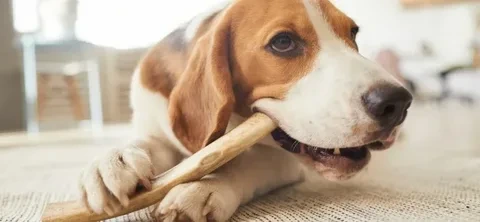
The simplest method of breaking the dog chewing toy cycle is by providing the befitting item to chew. Select non-toxic sturdy toys of the right size and chewer ability of your dog.
Good substitutes would include rubber toys, rope toys, and nylon bones. Sometimes it is good to get them upside down as well to have your dog on its feet.
Increase Physical and Mental Exercise
A dog will never be at peace though it is bored. Make sure you exercise your dog day by day. Go on long walks, play fetch or teach tricks.
Puzzle feeders and treat-dispensing toys are also another method by which the dog can be kept busy in his thoughts.
Automatically, the amount of chewing will reduce as your dog is out of tiredness and mentally satisfied.
Train With Positive Reinforcement
When your dog chews toy the right thing praise your dog or give it a small reward. This is one way of teaching your dog that there are rewards to good decisions.
Whenever your dog gets into chewing something that it does not want to, just get it out and play with one of those toys of chewing. Rather direct it to the right direction.
Keep Temptations Out of Reach
Dogs are inquisitive and therefore prevention is relevant. Remain out of reach of a dog a pair of shoes and a pair of socks and even children toys. Where a dog has cheating habits, restrict access to the rooms, where possible. Make safe areas using baby gates or closed doors.
Use Dog-Safe Deterrent Sprays
Sprays that are bitter can prevent chewing gums to lure on furniture or any other valuable objects.
Put them around where your dog tends to chew but never put it on a large area because it may become damaged. Training and redirection are most effective with deterrents.
Effective Training Techniques
In chewing problems, training is necessary. The following are some strategies that can help one create good habits.
Teach the “Leave It” Command
It is a simple, yet powerful command. Take something to eat, tell your dog leave it and watch until your dog tries to get the treat. Reward the dog, as you develop a habit of streaming away or looking at you, with another thing.
Develop a Daily Routine
Dogs also get a sense of security and they are relaxed more when they anticipate something. Have an ordinary walking and playing time with the dog. Regular time helps relieve anxiety and ensures that your dog in this case does not chew in order to relieve it.
Supervise and Redirect
Supervision is also important, particular to the puppies. Praise the right conduct at the moment. In due time, your dog is going to learn what is permissible.
What You Should Avoid
In the attempt to find out such questions as how can I get my dog to stop chewing it is equally vital to learn what not to do.
- Do not yell or hit your dog. This develops fear and can worsen the situation.
- Do not run after your dog because of stolen stuff.
- Do not ignore the problem. Chewing destructive is not likely to leave of its own accord.
When Seek Professional Help
You can refer to a professional trainer or behaviorist in case your dog is still chewing without giving up despite regular training and exercise.
In some instances, chewing may indicate underlying or larger problems such as extreme anxiety, frustration or even pain in the teeth. A doctor will eliminate medical reasons and propose sound solutions.
Final Thoughts
To conclude you will get the answer How Can I Get My Dog To Stop Chewing . To teach your dog to quit its destructive chewing habit, you are forced to wait, be patient and be consistent.
Keep in mind, that it is a normal way of behavior among your dog and he/she chews. You do not want to quit chewing yet you just want to channel it to healthy and safe sources.
When you know the needs of your dog, provide him with the correctly chosen toys, provide him with exercises, and train him with love, you could save your belongings and ensure your connection with the pet.
To have further professional guidance on dog health, training, and care, go to the Animals Pet Health that will enable you to have healthy and happy pets.
FAQS
why my dog chews furniture?
The dog can chew on furniture because of boredom, anxiety or teething. Chewing toys and receiving more exercise can be used to reduction this behavior.
What is the duration of cessation of destructive chewing?
Time is relative but with regular training and redirection, the situation improves within several weeks.
Can chewing harm my dog?
Yes, numerous objects that are hazardous to be chewed, such as wires, sharp objects, may hurt your dog. Keep a watch and dog on your house.
Are there chewing-stop-products?
Yes, there are taste warning sprays and harder chew toys which discourage unwanted chewing.
Is chewing a sign of anxiety?
Yes, it’s a pretty common thing that dogs with separation anxiety will chew on something to calm down when they are left alone.